MY CHILDHOOD

I have often speculated as to why my father left me with his disaffected and frankly unhinged young mistress.

His diaries, which I still have, are full of guilt and distraught thoughts about the situation. Entries like this:

‘I’m so worried about Mandy. Dorothy is so nasty to her. I don’t know what to do’.

‘How can I protect Mandy from Dorothy’.

But you could see his dilemma. He had two wives – one an ex ( my mother), and a more recent one, who both -flatly- didn’t want to have anything to do with me. They had absolutely no intention of having a kid to raise.

He, also, had to work to make enough money to fund us, and the new wife.

Finally, it was quite convenient for him to have access to Dorothy, by keeping her there, and giving her a reason to stay there. Me.

What is far worse than the general physical neglect that so many children suffer is the verbal and mental abuse. Bruises heal, but , if you are constantly told – on a daily basis, as I was, that you are ‘Stupid’, ‘Useless’, ‘A waste of space’, ‘Good for nothing’, ‘Ugly’, those words last a lifetime. One thing I’ve learned is that the people who belittle one the most are usually without any talent, ability or skill of their own whatsoever.

My mother had a good line in put-downs, too. Apart from her early mantra of ‘Go away, leave me alone’. Much later in life she once said to me:

‘You’ll never get married’. And I answered ‘Why is that’. Her retort:

‘Only pretty girls get married’.

Astonishingly, I managed to pass the 11+ exam, and I gained a place at Brentwood County High School for Girls. Along with my friend, Gail Bracken. Only two of us had passed out of our class of 30-odd kids.

Fortunately, for my father, there was a boarding house attached ( for 50 boarders), and I gained a place. So I arrived there, with a complete trunk of school clothes a few days before my 11th birthday. I was scared, but safe at last. Never homesick. I had no home to miss.

My father and Dorothy more or less ‘threw away the key’. I rarely, if ever, saw them, or went to their new house. I stayed with school friends for the holidays.

By then, my father had divorced the second wife, and was now living full-time with Dorothy in a swish new build on an exclusive estate called Hutton Mount, near Shenfield. A very short distance from my school.

But things were no better there.

Only in my last two years in the Sixth Form did I live with them.

And in great fear. I kept my bedroom door locked at night, as I was terrified that she would attack me. She frequently went for my father, trying to garotte and kill him. I’d have to pull her off.

I kept a diary during those two years, and was astonished at the amount of housework I had to do, as they were both working in London.

I’d have to wash and seal the kitchen floor before going to school.

I used to hoover, wash the living room curtains, de-frost the fridge, and prepare evening meals for them. I even painted the bathroom!.

Reminiscent of my Cinderella status at our 17th century cottage, with its large , open fireplace. It was my job to clean out the coals, and lay the fire. As well as feed, groom and generally look after Windsor, which I loved to do. And clean out drawers and cupboards, for a weekly inspection by Dot. Another one of her sadistic past-times. God forbid if my bedroom was untidy. I’d get such a tongue lashing.

One day my father vanished. In fear of his life. He went to London, met a woman whose home was in Australia, married her, and fled the country,leaving his house, belongings, paintings, antiques and beloved Sunbeam Alpine behind.

He and Dorothy never met again.

But , on her death-bed ,she lost her mind, and kept talking about how much she wanted to be with him.

She also apologised to me about the way she had treated me as a child, saying:

‘When you were young, you were vulnerable and terrified, as I am now@

She was screaming in agony with rapidly aggressive cancer. I begged the doctors to give her more pain relief. She died, mercifully of a cerebral thrombosis.

And she left all her property to me, as recompense.

MY CHILDHOOD

In the coming years, I was left in the sole care of Dorothy.

A deeply disturbed young woman, who had absolutely no wish nor inclination to look after me.

Why should she?

My father had put us both in a remote country cottage in Essex, and visited us , reluctantly, every six weeks, while he lived in Hampstead (Fitzjohn’s Avenue), apparently, with his second wife, Sonia. His visits became more and more erratic, and I had no idea where he was living.

When he dared to visit us, there would be horrendous rows -‘scenes’ between him and his discarded and neglected young mistress, who would launch into murderous attacks on him.

She chain-smoked most of the money left for our upkeep, which meant that food was in short supply. Sometimes we’d pull up the floorboards to see if there were any coins there.

I dreaded her running out of cigarettes, which calmed her. Without them, I was in big trouble. Then, she would rage at me, push me around. Lock me in cupboards. I would count how many cigarettes she had left.

Knowing, terrified, that her temper would be ‘out of control’ without them.

I began to know what ‘food insecurity’ means. I never knew if food would be provided. She’d cook egg and fried potatoes, or occasionally, or a pork chop would be thrown in front of me, usually in sullen silence. There was often no ‘dinner money’ for me for school meals, so I’d have to walk home at lunchtime. To eat or usually not to eat lunch. I was permanently hungry.

I survived because a kind teacher, taking pity on me , would invite me to her home, once a week, for a meal, and some extra 11 plus tuition.

For once, I’d eat at a nicely laid table, with a crisp, clean tablecloth, in a pretty dining room, overlooking their pretty garden. An oasis of peace.

I am utterly grateful to Wendy and Peter Dawson, for feeding me.

For the first time in my life, I enjoyed delicious salads – and peanuts!

There were also a couple – Sam and Ada – who were our nearest neighbours. About half a mile away. Sam, was a farm labourer, and Ada, his disabled wife. They were childless. Miraculously, they were concerned about me. And, every day, on my way home from school, I’d call on them, and they’d give me ‘tea’. Fresh home-made bread, butter and Tiptree jam. And fruit! They once brought me a pomegranate.

I’ve loved that fruit ever since.

I’d scrump a lot: apples and pears. And I remember making myself pear sandwiches with some sprinkled sugar on top. Delicious.

I’d listen to Sam and Ada talking about how worried they were about my welfare. I had so few clothes. In summer, one pair of shorts, a sleeveless top. Open-toed sandals. In winter, brown cord trousers and a grey, knitted cardigan.

There were holes in my shoes. I would put newspaper in them

I was a wild, feral, unkempt child.

Every day, I’d get up early to go to school. A mile or so walk.

Dot, as we called her ,didn’t get out of bed until midday, so I never saw her.

My little country primary school was my refuge. A place of safety.

Here I’d get a small bottle of free milk, and a lunch, if I was lucky.

To this day, I can still remember the names and faces of all those lovely country kids in my class.

They were my friends. Family.

We did exciting things like reading good poetry aloud, acting in plays. I always seemed to get the leading parts: Snow White, Aladdin ( bit of cross-dressing there), the Virgin Mary in the Nativity. I was an articulate kid. I read non-stop. Ransome ( ‘Swallows & Amazons’); ‘Anne of Green Gables’ – all of L.M. Montgomery. ‘Black Beauty’, ‘Little Women’.’Just William’. ‘The Borrowers’.These were some of my favourite books.

More friends.

And it was into the vibrant atmosphere of this happy, little village school, that I began to write poetry. My first attempts, which I illustrated with little drawings were entitled ‘Panorama’, and ‘April’,and I then wrote a short story called ‘The Rectory Children’. I still have these fledgling literary offerings. Juvenilia.

I was obviously a country child , as the opening lines of ‘April’ attest:

‘April is the child of spring/she reigns for thirty days/She brings the daffodils on hillocks green/the daisies that spring on grass-edged ways’.

And the opening stanza of ‘Panorama’:

‘The grass is wet beneath my feet/And a warm wind ruffles my hair/I sit on the hill, and think and think of a life without a care’.

It’s melancholic in tone, and next to it is a picture I drew of myself in my uniform of shorts, top and open-toed sandals, and my short- cropped boyish hair.

The embryonic writer had arrived. And as Doris Lessing once observed ‘the best training for any writer is an unhappy childhood’.

The poems aren’t dated, but I was aged between 7-10 yrs old when they were written.

Another fragment from this time is that I won first prize in an essay-writing competition, aged 10, given by Cadbury’s. I have no idea what the subject was, but my father kept the certificate for years, and I was to develop a desire to appear in print, especially as the prize was several bars of chocolate! Again, I owe so much to my teacher, Mrs Dawson, who probably entered me into the competition, and inspired my passion for poetry, by reading the glorious poems of John Masefield to us.

Out of school, we climbed haystacks, looked at moorhen nests and the little chicks, rode ponies ( without safety helmets in those days).

My pony was called Samba. I loved him.

At weekends, and school holidays, ever reluctant not to be at the cottage, I’d hang around the homes of these kids, cadging food, watching how ‘normal’ families worked. Seeing what mothers did.

Although I have absolutely no memory of a single birthday or Christmas after the age of five, I do recall being given a rusty old second-hand bike.

And a puppy!

‘Windsor’ was a glorious golden cocker spaniel – the joy of my life!

My buddy and companion. I’d take him for long walks in the fields behind the cottage, watching him chase rabbits.

But twice we nearly lost him. Firstly, my father ‘forgot’ to have him vaccinated, and, as a tiny puppy, he got distemper and hardpad.

I will never forget the fear ,terror and anguish I felt at seeing this little scrap fighting for his life. Desperately ill. Miraculously, he pulled through. Sheer love and my desperation might have helped. He was all I had.

Another time, he escaped out of our cottage enclave onto the road, and was knocked down by a car. I will never forgot the howls and screams of pain he was in. Someone, negligently, hadn’t closed the gate to the place.

I froze in complete terror.

He was paralysed with a damaged spine. His back legs didn’t work.

He dragged his poor etiolated legs behind him,wrapped in bandages. There was talk of ‘putting him down’. I absolutely refused to let them do this, and promised I’d massage his legs, and pinch his paws back into life. It took me weeks of therapy doing this. But there was a tiny spark in his legs, and one day, again ,miraculously, he stood up very shakily, and walked. His muscles were always very wasted. But he walked , with a stagger, for the rest of his life.

There was another sad outcome of having my beloved puppy. We had acquired him from a local kennel. And the owner, a Mr Brown, seeing how much I loved puppies, invited me to come round, after school, to help play with and socialise them. I was thrilled to bits. This became an almost daily occurrence. But, there was a dark side to this. After my time spent with the little animals, Mr Brown would take me into the aptly-named ‘stripping shed’, take all my clothes off, and place me naked on a table, where he would poke around my genitals, and masturbate.

Once, he brought a young boy in, and the masturbated together.

I was transfixed with fear.

Then an extraordinary thing happened. I returned to the cottage, late as usual, to find my Scottish grandmother, Ada, there. She had made the journey all the way from Glasgow, ( her only time) to visit her only grandchild. Naturally, she asked me why I was so late, and where I had been. And, in my innocence, I told her exactly what was happening. Never have I seen such an outburst.

She grabbed the phone, and called the police immediately. The next thing there were tons ( to me) of people in the cottage. Questioning me.

The outcome was a court appearance. I had to testify. In those days, children were grilled by barristers in court. I remember being scared to death, as Mr Brown was in court. It was such luck,however, that I was rescued by Ada. It turned out that Brown was raping and buggering a thirteen year old girl and her brother ( they were twins) , and that he was a recidivist paedophile. He was sent to Broadmoor.

One thing I remember about the trial was the aggressive questioning of the defence barrister, and how I managed to demolish his arguments.

And, ever fashion conscious about my few clothes, I had been dressed in a sweet little kilt and a canary yellow jumper for the trial. I must’ve had some new shoes, too. They all must’ve been bought especially for this court appearance.

Regarding clothes, as a five year old, plus, living in Germany, I’d had some very pretty silk dresses, which I loved. Silk. Smocked.I had also had long hair .Plaited, My father kept one of my plaits. I still have it.

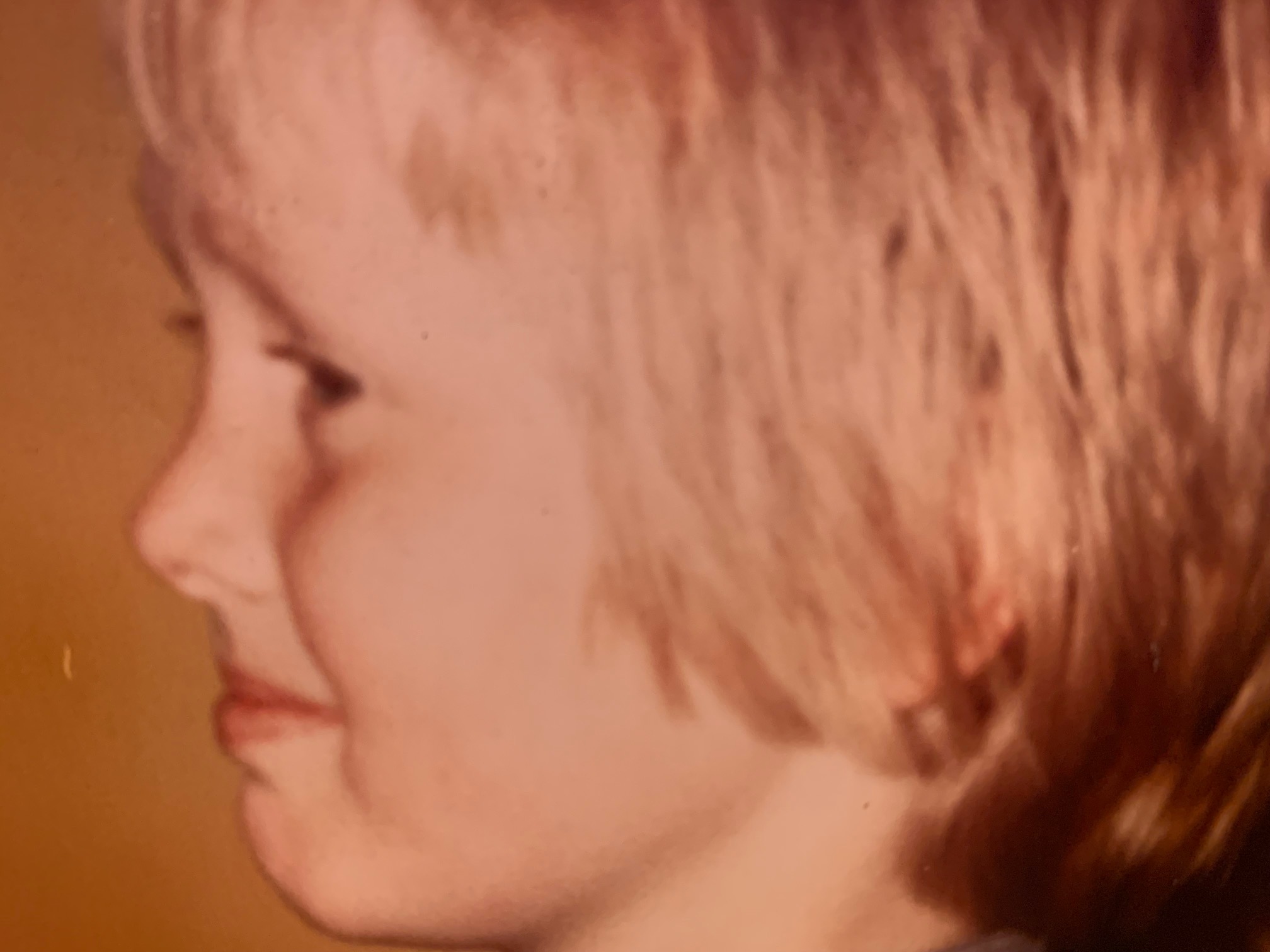
But under Dot’s regime, my hair was always chopped short, like a boy’s.

I dreaded having my hair cut like this, and would always cry. And, again,

Dot’s mocking eyes would flash with glee when she saw my distress.

Result. To this day, I have a horror of having my hair cut.

Life at the cottage started to get darker.

I got very ill with mumps. Suddenly, my father appeared, with his young wife, Sonia It was the only time I met her. Their eyes seemed filled with fear, as they surrounded my bed. Dot made me soft boiled egg chopped up with white bread to eat.

It was disgusting.

Worse was to come. Poor Dorothy became pregnant Her rages and smoking got worse. She never left the cottage. No hospital visits, or check-ups. She just hid away in shame, poor girl.

The tragic baby boy – Graham – was stillborn.

I felt sad but also relieved that he would be spared a terrible life living with us. And I , at ten years old, was left to care for this demented, bleeding , crying , leaking woman. I witnessed her swollen breasts, dripping milk. The blood soaked sanitary pads everywhere.

She would cling to me, weeping copiously. Such grief. But , sadly, I felt nothing.

My heart was a stone.

It was also the only time that I was mercilessly bullied at school, by a girl called Geraldine. I will never forget her. She taunted me for my ‘irregular’ and scandalous home life. But I fought back. God knows how I found the strength.

Understandably, Dorothy was now almost on the verge of psychotic madness by now. My father appeared less and less.

The school holidays were looming, and I dreaded the endless days and nights that lay ahead.

One day, completely ‘out of the blue’ my mother turned up. She stayed a night at the cottage, completely ignored me, and had a blazing row with Dot. The next morning she rose at the crack of dawn to get a train to London to her work. I explained my plight and fear at being left alone to deal with Dot’s moods, and begged her to take me with her. She refused. And with her characteristic annoyance she told me to ‘leave her alone’,as she was in a hurry to leave.

By now, I was desperate. Dressed in my uniform of shorts, top and open-toed sandals, I managed to grab a green raincoat, and jumped over the garden wall onto the soft, wet grass. I didn’t go by the gate, as I feared the click would wake Dot. It was half past five in the morning.

I had decided to run away.

Firstly I walked the 4 or so miles to Billericay. There, I knew a family called The Wheatley’s. Mum, Dad, two boys – Chris and Nick.

I stayed there until around 6pm, when it was starting to get a bit darker, but not much – it was summer, when the mother urged me to walk back home. In those days, kids walked everywhere. There were few buses, and cars were a luxury. I never saw a country bus, as far as I remember.

Of course, I was never going to do this, so I just followed the road to London. By the time the police picked me up, around 9pm, it was already dark, and I must have walked for miles. I was exhausted. And was ferried swiftly to the nearest police station. I have no idea where it was, but Dot must’ve raised the alarm ( we had a telephone), when I didn’t return home.

A lovely policeman, Detective Inspector ‘Dusty’ Smith (I’ll never forget his kind, concerned face) interviewed me with great sensitivity and kindness. Abused children are very impressed by gentle people. They aren’t used to them. About an hour or two later, my ashen-faced father arrrived from London. He took me away. Not to the cottage, but to a local hotel, and then on to Jersey for a holiday.

I never returned to Milestone Cottage.
MY CHILDHOOD

From 5-18 years old, I lived in fear, in a household where there was daily violence, abuse and anger. My cortisol levels were so high, I don’t think they’ve ever come down!

And I’m nearly 80 now.

Still plagued with life-long nightmares about these years, but , which are now, mercifully, less frequent.

Sadly, many children are living like this right now. My situation wasn’t unique.

But this is my story.

After my parents divorced, my father took up with an eighteen -year old girl, who was mentally deranged. She wanted my father all to herself, and I was in the way. An obstacle.

We were living in post-war Germany at the time. My mother had vanished back to the UK, and my father had obtained full custody of me in their divorce. Almost unheard of in 1950. But my mother wanted nothing to do with me.

However, my father was frequently absent, as he was working for the Foreign Office in the Transport division (British Element), helping in the restructuring of the country’s roads, railways, and so on.

I was largely looked after by a Polish nanny,Cecilia ( very young and sweet), and a German couple – Elsa ( the cook) and Willi ( the gardener).

We were a close-knit little family, and I was well cared-for, and, importantly, greatly loved. I recall lots of cuddles,kisses and many kindnesses, and treats. I was their ‘Mandylein’.

But into this idyll, ‘Dorothy’ arrived. And I shall never forget the terror I felt when I first looked into her dark eyes, full of raging anger. Suddenly, she had the opportunity spend time with me. I wished constantly that she would just go back to where she had come from.

She used to play this game with me that terrified me. She’d wrap me up in a rough, woollen army blanket. I can still feel its coarseness against my skin. Then tie me up, so I was in a confined bag. She would then hurl me round and round the room. I was a slight child; she was a strong girl.

I’d scream with terror, as I became hotter and hotter. Gasping for air .Trapped. Until she finally chose to put me down on the floor, and let me out.

By then I was gasping for breath, in tears, covered in sweat. I still remember the sadistic, mocking look in her eyes, as she laughed cruelly at my distress. She was enjoying frightening me. She took pleasure in seeing my fear and vulnerability.

Result: life-long claustrophobia. To this day, I can only sit at the end of a row in a darkened theatre, or cinema. If not, I have a major panic attack, and have to escape. The fear is indescribable.

Little did I know that this was just the beginning of years of torture that awaited me.

HAMAD & MANDY – pt 2

We were a motley little group at the bowling lane. Irishman Danny, missing his home in Ireland, a lost girl, me, unsure of her choice of university, and young Hamad, achingly homesick and anxious about his future.

However, we all got along pretty well, so Hamad suggested that we meet every day for the rest of the week. He seemed desperately lonely, and needed our company.

So, for the next few days,this pattern was repeated. And Danny would drive down to Shenfield and then drive me home. Until Friday, when Hamad asked me if I’d spend the weekend with him.

I declined. I was keen to get back to my friends and life in Birmingham.

These were the days when I was called ‘Mandy’, and always felt slightly embarrassed to share this name with another rather notorious Mandy – the Rice-Davis one.

Much later, when I came to Brighton, I reverted to calling myself by my proper Christened name – Amanda, because so many people thought the name – Mandy – was rather ‘common’.

He sulkily accepted my decision. I felt that not many people said no to him.

For a few weeks , he would phone me at the university. And I got used to being teased mercilessly when the tannoy system would announce to all and sundry that there was a call for me from the Crown Prince of Bahrain.

Now when I am reminded of him when there is a Formula One meeting in Bahrain, or Amnesty protests about human rights’ violations there, I take a peep at photos of Hamad, and see a good -looking man with those same fine, direct brown eyes.

Only three years after I met him he was married at 18 to his first cousin.

And his son Salman, was born a year later.

In all, he has had four wives and 12 children now. But all I remember is the fretful and rather sweet young man who so urgently needed a friend to talk to all these years ago.

Hamad & Mandy

I met the newly annointed Crown Prince Hamad bin Isa Al Khalifa of Bahrain at a lavish party given for him in a glamorous house in Mayfair in 1964. I was just 19, and a ‘fresher’ at Birmingham university. In my first year there of a Philosophy degree course.

How I managed to be present at this rather louche party, given in Hamad’s honour, was somewhat surreal.

Because I had accompanied my father, rather hastily, to this function.

So much so, that I arrived with only freshly-washed hair, no make-up, and wearing a cheap little cotton dress from a shop called Neatawear, that no longer exists. In the fashion of the day, the skirt length was short.

The first thing I noticed were the girls. Seated on chairs around the room were several very young teenage European girls, mainly blonde, very pretty and heavily made-up. I realise now that they were high end call girls.

Hamad, who was barely 15 at the time, looked nervous, and was seated at a large, round table with several men, who all looked like security guards.

As I walked into the room – my father had disappeared somewhere, one of these guards approached me and said that Hamad would like me to join him. I had noticed him watching me, as I entered the room.

My absolute plainness and absence of any make-up might have intrigued him.

As we sat together, I noticed that his chubby, schoolboy fingers were covered in gold and diamond rings, and he was wearing a very fine, slightly shiny Alpaca suit. He seemed interested in me, asked me about my university course, and mentioned that he was quite nervous about going to officer cadet course training at Aldershot and later Sandhurst shortly. I noticed that he seemed quite sophisticated for his age.

Wordly, but possibly still a virgin.

Anyway, he was a freshman,of sorts, too! Our conversation bonded us.

I briefly left the table to go to the Ladies Room, were I was immediately surrounded by bevies of the pretty young girls who had been lining the rooms.

They were fascinated to know how I had ‘bagged’ the Crown prince, and congratulated me. They were slightly in awe of me. How had I achieved such a thing.

And, to my astonishment, when I returned to my seat next to Hamad, he asked for my address, and invited me to come to lunch with himat the Dorchester hotel the next day. He said that his chauffeur, Danny, would drive down to Shenfield , Essex, where I lived, in his Silver Cloud Rolls- Royce to fetch me. And this is exactly what happened.

Exactly on time, the next morning, this beautiful grey Rolls drove up, outside my house,and a uniformed Danny, opened the door for me, and drove us both up to London.

When I arrived at the Dorchester, I discovered that Hamad and his entourage of men occupied an entire floor.

But I noticed that there were still a group of girls lining the walls.

The women in his family, however, occupied another floor.

Lunch was served to us – only Hamad and I were at the table – and I found the food delicious, but I don’t recall what we ate.

After lunch, Hamad then said that he wanted to go bowling in Golders Green, and asked if I would go with him, which I duly did,

I

Women who Love too Much ( cont.)

Norwood describes that these kind of women often had abusive and neglectful parents who failed to ‘provide a basic sense of security and validation to their daughters in childhood, so that they are programmed endlessly to seek out men who remind them of these familiar familial abusive patterns.

These women want to fix things/people and make things right.

That old ‘Freudian repetition syndrome’. For to these women ,romantic love must be full of suffering, longing, pain and torment.

I think this can also apply to men, who may seek out abusive, emotionally unavailable woman who remind them of their neglectful mothers.

The hand that rocks the cradle is often the first individual a child meets who is abusive in some way.

I’m thinking of writing a sequel entitled ‘Women who Love too Little’, to all those women who failed to provide basic love , care and kindness to their offspring. And who set in motion these awful scenarios that are constantly repeated in life. For, as we all know, it’s the sub-conscious that runs the show.

And, incidentally , people who become therapists and counsellors and who are drawn to their craft, are often the very people who experienced some form of emotional neglect themselves.They are usually more ‘fucked up’ than their unwitting clients.

But all these dysfunctional patterns are established in childhood.

Parents really do ‘fuck you up’, as Philip Larkin so eloquently put it.

Women Who Love Too Much

I recently picked up my copy of this seminal book from my bookshelf to re-read some of the wisdom described in it.

It’s a classic. One of the first relationship self-help books in the genre, written by Robin Norwood, a family and relationship therapist, in 1985.

Its premise is simple. It describes a certain kind of woman who seeks out emotionally unavailable partners, and deeply dysfunctional men in order to help, even rescue and save them. Thereby sacrificing their own needs.

Setting Sail: Remembering Jonathan Raban – part 2

In 1970 , I graduated, and also came to London to seek my fortune.

I had no idea which career to pursue, so I dabbled in publishing ( I worked for Cambridge University Press), journalism ( wrote book reviews/pieces for Twentieth Century magazine and Arts Review), did some academic research, then settled into running the Workshop gallery for Mel Calman. I was drifting. Uncertain which career path to take. At one point Jonathan said:

‘Make me your career’.

But I was eager to move on from him, find a loving partner, and start a family.

Jonathan had found his metier, his dharma, his ‘raison d’etre’, and was writing plays, short stories and reviews for ‘The New Statesman’, ‘The Sunday Times’ and countless other newspapers ,BBC and so on.

But in June 1972, around Jonathan’s 30th birthday, we collaborated on our last joint venture together when our son Alexander was conceived.

I am eternally indebted to Jonathan for the gift of my beloved son, and now for my enchanting granddaughter, Esther.

l then went on to meet and marry my marvellous husband, Nicholas Sewell in 1979, who loved Alexander and raised him as his own until his untimely death in 2010.

And in recent months, Alex and his father were in contact with each other before his unexpectedly sad passing.

R.I.P. Jonathan.

Pictures of Esther and Alexander below.

Setting Sail: remembering Jonathan Raban

(June 14 1942- January 17 2023)

I was 22 when I first met Jonathan at the University of East Anglia. I was a student in a class he was giving on American poetry. He was 25 then, and a junior lecturer in the Department of English and American Studies.

I was older than my compatriots because I had worked at the V&A museum in London and spent a year at the University of Birmingham, reading Philosophy before taking up my degree in Fine Arts at UEA.

But I had been writing poetry from a young age, and Jonathan was interested in looking at my work. It was the first time in my life that anyone had taken my little poems seriously, although I had already been published in magazines and ‘Sprouts on Helicon’ (Deutsch).

Jonathan took out a red pen and corrected, advised and made alterations and suggestions to my work. Here was a bright, brilliant, enthusiastic young man, full of energy and enthusiasm, who was eager to encourage me. I had never met anyone so full of life. He was vital, fun and dynamic. On the brink of leaving university teaching and academia to become a full-time writer. I knew him then as the fledgling about to leave the nest. It was an exhilarating time for both of us.

I introduced him to my friends the poet George MacBeth and to Prof.M.L. ‘Mack’ Rosenthal .He invited both of them to lecture to the Faculty. Jonathan had a sweetness about him then. He wanted avidly to extend his circle. We became close at this time.

Friends as well as lovers. He moved into my flat and wrote a short story

that was published in ‘London Magazine’. We were both thrilled,and celebrated this triumph together. It was the beginning of his literary career. I sent a poem off to ‘The Listener’, and it was published in July 1969. Again, we celebrated. It was our annus mirabilis. It was the year he left UEA and went to London to become a full-time writer.

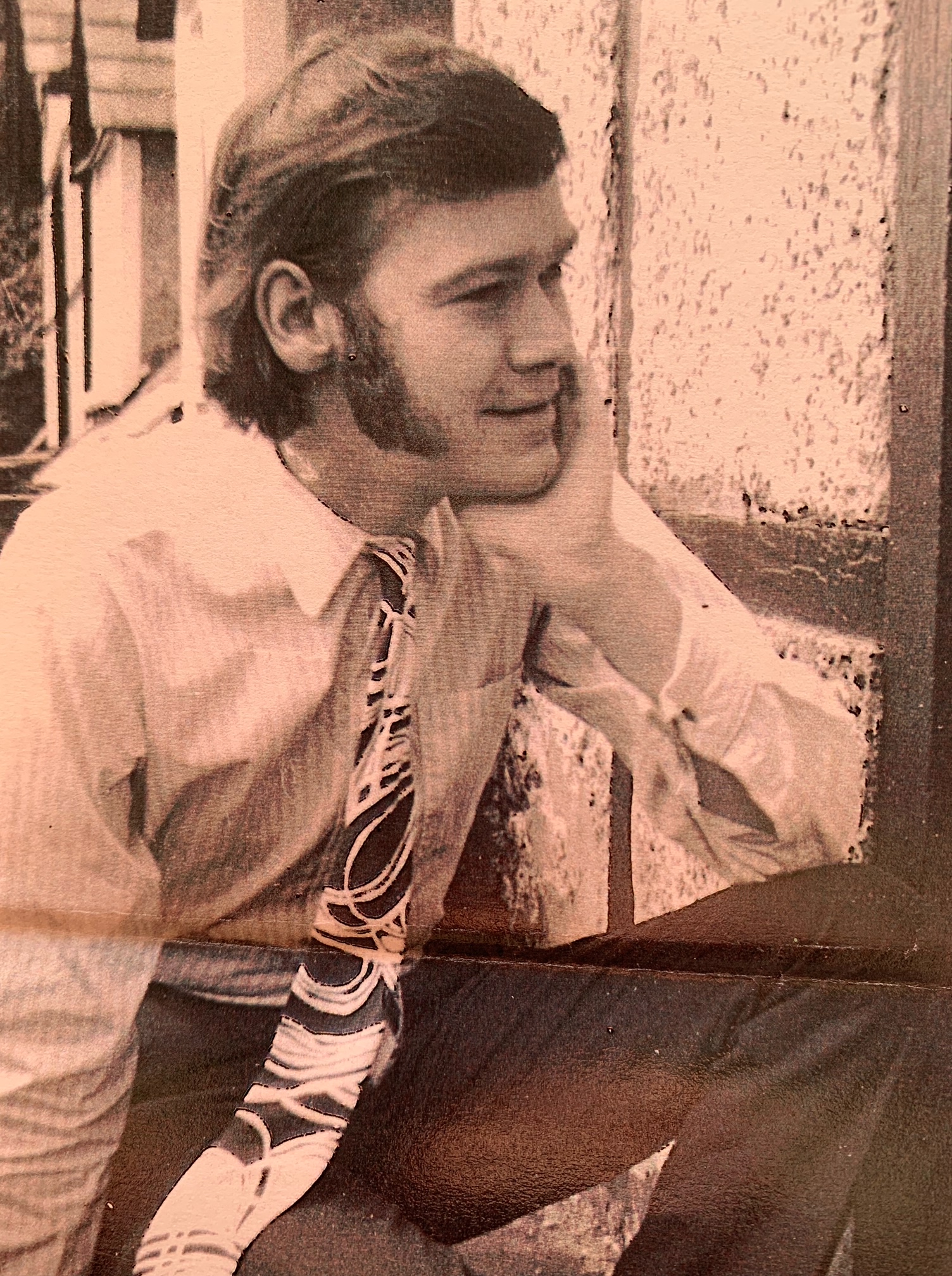
Picture of Jonathan taken on the balcony of his flat in Unthank Road, Norwich. June 1969. The tie was a gift from me. I took the photos and ironed the shirt.

THE PRINCE WHO CAME TO TEA.

AFTERMATH,

In the days that followed the visit of Prince Charles to our home, I was

recognised in the streets around us ( We had made the front page of the local newspaper ‘The Evening Argus’ -an exclusive – with photos), and people constantly approached me for first-hand information on Charles. This became tiresome. My friends jokingly referred to me as ‘Your Royal Tea-ness’, which I loved.

In the end the pressure of it all became too much, so I took myself off for the weekend to Rye, to escape back to anonymity. I had become sick to death of being approached by people . How do ‘celebrities’ stand it.

Some go around in disguise, I’ve discovered, but others need to be recognised like my friends Martin Bell, and the late Anna Wing, the actress. Both were disappointed whenever they weren’t recognised.

However, when I returned after my weekend away, I decided to accept the invitation from BBC Radio Sussex , as it was at the time, to give an interview ( over the phone – a landline in those days) to a news programme.

The interview went well. The questions were general: ‘Did he take sugar?

What did he look like? What did he think of your house? ‘Where you nervous talking to him ? Etc. Etc,.

But the other thing I had to put up with was the amount of threatening hate mail I received from militant republicans. This was another reason why I fled to Rye.

I decided to ‘fight fire with fire’ to the writers of these letters, tell them that they were ‘preaching to the converted’, that I’d never been much of a royalist, but that I had invited him in ‘for a laugh’.

Much of this was true.

However, in this platinum Jubilee of the Queen’s 70 -year reign, more attention is being focused now on her likely successor : Prince Charles.

And all I can say is that I have become a real fan.

Even today on Sunday July 3 2022 I heard on the Paddy O’Connell programme on BBC 4,the journalist, Matthew Parris defend Prince Charles against some of his detractors, and I had to go along with him.

I think Charles is a good and honourable man, and will be an almost ideal and appropriate King to have in the following tumultous years to come .

He is our best bet in these uncertain times and in place of the most nefarious bunch of politicians we’ve had in a long time.

@