THE PRINCE WHO CAME TO TEA

Charles then started to ask about various artefacts in our living room, and was particularly intrigued by legions of wooden figurines of soldiers in military colours and clothes from various 18th and 19h century regiments that lined the walls, and had been made by Nick.

At one point, he asked: ‘Well how did you do this all?’

‘With hard work’, Nick replied.

By now, a large crowd of people had gathered outside the house, and there were photographers gathered outside. Our sitting room, too , was crammed with security people and the Press. When, suddenly Charles said:

‘Would you mind awfully if I looked round the rest of the house?’.

At this point, I almost collapsed at the thought of unmade beds and untidy bathrooms.

Charles looked outside and then said; ‘I think they can wait’.

I then ushered him up to the staircase, he went up, then I followed,

pointing out various views of Brighton lining the walls.

‘Look, sir, I said’, here’s a picture of the Theatre Royal’, or here’s a pen and ink drawing of the Royal Pavilion’, Places that I thought might interest him.

He looked into each room briefly, and with interest, going past the ‘belle etage’ of our large Victorian town house until we reached a large bedroom, where he admired some glass handkerchief vases. I then offered one, which he politely refused. Then Nick chimed in with the following remark: ‘

‘Well the old Queen Mary would’ve taken it, wouldn’t she?’

At this , Prince Charles laughed and Nick then recounted how Queen Mary had patted him on the head as a child, as Nick’s parents who lived in Little Chester Street, Chelsea, and often went to the Chelsea Arts Club, were aquainted with her. Nick described a dark green car that she had with a basket seat at the back, and Charles laughed in astonishment that he, too, knew of this vehicle.

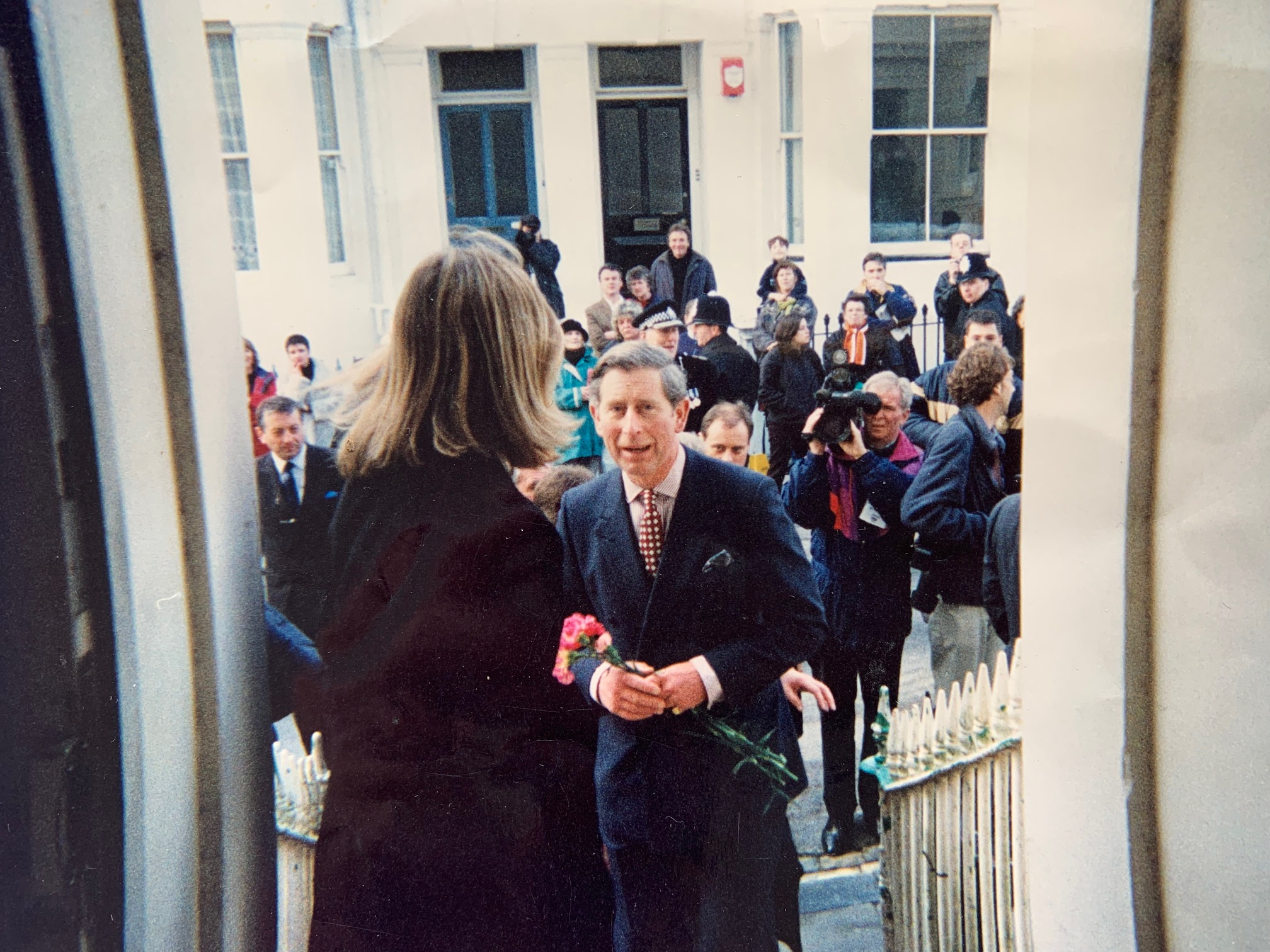
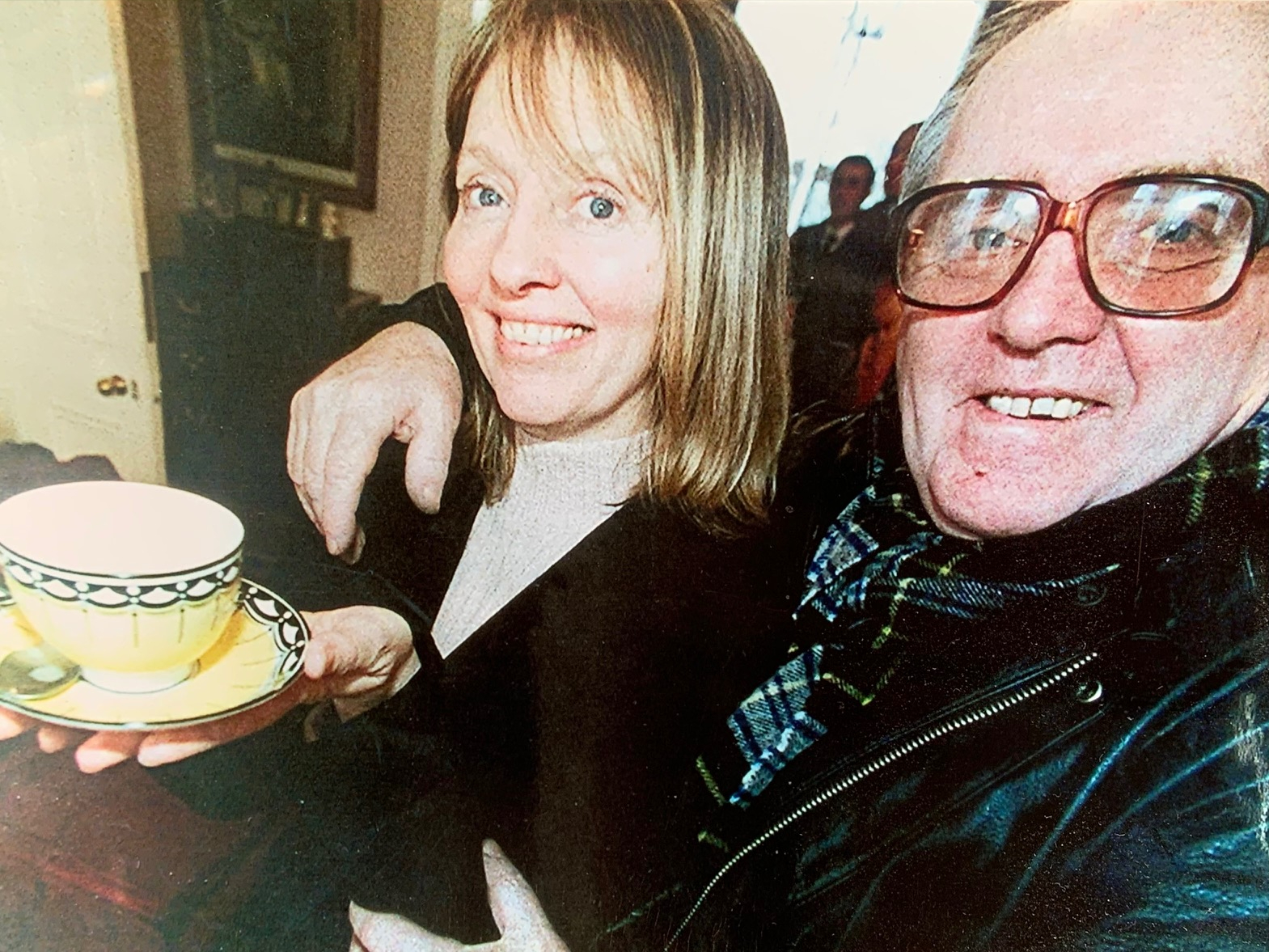
The two men, who were both of the same build and size ,then bonded as brothers, and continued to chat and reminisce. And a photographer was later to take a lovely photo of a very happy and similing Prince Charles leaving our house, with my beloved Nick on the front steps with him.

As soon as Charles’ entourage left to dash off to the waiting helicopter, the phone started ringing. It was ‘The Daily Mail’ , ‘The Mirror’ and ‘Hello’ magazine on the end of the line.
THE PRINCE WHO CAME TO TEA

I offered a seat to Charles on our comfortable red velvet chinoiserie settee, and he relaxed completely, and looked intently round the room , with much interest and curiosity.

With good reason, as the room was a tastefully-decorated treasure trove of fine antiques collected by my husband over the years.

It isn’t every day that members of the royal family visit an ordinary commoner’s home. If ever!

I sat on a pink velvet upholstered Victorian chair opposite him, and asked him how he took his Earl Grey tea, which was what I offered to him.

‘With milk and two sugars, please’ he replied.

I was surprised at the request for sugar, and I told one of his entourage what he wanted. This was relayed to my husband in the kitchen.

Nick, my husband, duly arrived with a cup of tea, gave it to Charles, and then plonked himself down next to Charles. I was a little alarmed at this complete lack of solicitude on his part.

‘Hello Charles’, he said.

I winced,as I had been adding ‘sir’ to every utterance.

THE PRINCE WHO CAME TO TEA

At 3pm precisely, a fleet of immaculate limousines swished up College Road, and a rather bemused Prince Charles alighted from one of them, surrounded by his security team and his Press secretary.

A growing crowd of people had gathered to see him.

It was a cold but sunny day, so I put on a rather fetching faux fur hat to greet him.

I went out onto the entrance of our house, and watched him climbing the stairs down to a basement entrance, at which I called out to him, thus:

‘When you are finished in there, sir, would you like a cup of tea?’

He looked straight up at me, smiled, and replied:

‘Yes. A great idea’.

Truly astonished I and raced back into the house, calling out to my husband to put the kettle on.

Almost immediately, a group of plain clothes security men turned up at our front door to check us out. To case the joint and see if we posed some kind of security threat . They were most displeased with me ,as I had managed to wreck the entire afternoon’s schedule and timetable with my cheeky request.

I was not to know that there was a helicopter on stand-by, just down the road in East Brighton park, waiting to whisk Charles and his entourage back to Highgrove, and that this would now have to be delayed.

I had ruined their well-laid plans.

Suddenly, a slightly flustered Charles arrived at our front door. I welcomed him in politely and warmly, and watched him nervously playing with his cuff links as he walked into our sitting room, at which point he doubled up with laughter, as he saw an original Ingres print of a young Napoleon Bonaparte on one of the walls. My late husband was an avid collector of Napoleana.

This broke the ice, and laughing with him I swiftly pointed out another painting on an adjacent wall.

‘But we’ve got Wellington over here’. I said.

The Prince who came to tea

‘What time will he be here’, I asked the policeman.

‘Well, he’s visiting the West Pier at some point, and should be here around 3pm,’ was his reply.

‘I may ask him in for a cup of tea then’, I said jokingly, and walked in to the house to tell my husband.

Nick, a staunch Republican ,was uninterested and unimpressed.

I repeated what I’d said to the policeman, and Nick laughed and left for work.

I immediately hoovered the carpet in the front room, got out a silver tray,

and placed cups and saucers on it.

I went to Forfar’s the bakers’s and bought a Victoria sponge cake.

As I had a day off work, I then rang a few friends and asked them if they would like to come to tea, as I was going to invite Prince Charles.

Everyone laughed at me.

The Prince who came to tea

I woke up on the morning of February 18th, 1998, to find that our street in Kemp Town, Brighton ,was completely empty of cars.

Normally, College Road, which leads up directly towards Brighton College, and has double yellow lines on both sides is gridlocked with parked cars.

However, standing outside No 3 College Road, next door to our own house, was a policeman.

‘What on earth is happening ‘, I asked him.

‘Well, it’s all rather hush-hush’, he replied, but Prince Charles is coming here this afternoon’.

‘Why’, I asked, incredulously.

‘To open this home for the homeless. They’ve spent £3 million doing it up’

I had noticed work being done next door, but had no idea what was planned for this particular residence.

Remembering Lancelot Clark with my Kit.

It has been 4 years since Lance’s sad death, and I am still living in my seafront flat that overlooks Rottingdean beach. It is in an Art Deco building, designed by R.W.H. Jones (1900-1965) and was built in 1937.I have also kept my little cottage, which is locally listed.

Lance used to visit both my properties, and he told me that if he were to die suddenly that he wanted me to have his beloved dog Kit. I, and only I, could be his next owner, because I adored Kit, and Lance knew that I would provide him with the perfect life. And this I have attempted to do in the last four years with my darling boy, who enjoys the beach every day, and the joys of my 90′ cottage garden.

I am indebted daily to beloved Lance for this precious gift of Kit to me.

A perfect, sensationally glorious Golden retriever.

Kit truly is the love of my life, and the best companion ever. He is loved by everyone, as he is the kindest, most affable and affectionate animal, who brightens up everyone’s day with his jaunty walk, wagging tail and eagerness to ‘meet and greet’ everyone. He is a dog in a million. Pure therapy. He brings such joy to people – all and sundry, with special love for the lonely, the elderly and small children. He also loves girls!

He is also such a breath-takingly handsome dog that everyone wants to touch him, stroke him and take photographs of him. No walk is without someone shouting out;’What a beautiful dog!’.

He has almost zero interest in other dogs, incidentally!

Without Kit’s companionship the Covid lockdowns would’ve been unbearable. And he also loves my son and granddaughter dearly, and they love him.

I was the last person to talk to Lance on the night he died, and the Clark family kindly respected Lance’s dying wish for me to have his wonderful dog.

Buying this flat was a wild ‘jeu d’esprit’, but if I hadn’t I would never have met Lance or Kit.

Lance loved the views of the sea from my balcony,and I quoted these lines by Tennyson at his funeral.

‘You came, and looked, and loved the view

Long-known and loved by me.

Green Sussex fading into view

with one gray glimpse of sea’

Prologue from ‘General Hamley’ by Tennyson 1885.

I miss you, darling Lance, every single day.

‘Keeping Sane in an Insane World’. Pt. 2 : British Humour

Without Private Eye, which is published fortnightly, I would not have made it through Brexit, and it continues to provide solace for me now, as it has done for years.  It is wickedly funny.

Its articles, comments, jokes and cartoons are superlative, and its house-style follows  in the glorious tradition of satirical humour that goes back to the eighteenth century. To the work of Hogarth, Thomas Cruickshank and James Gilray.

I truly feel that we live in a second ‘golden age’ of cartoonists, shown in the work of the outstanding  Steve Bell, who lives in Brighton, Martin Rowson, Ben Jennings, Christian Adams, Morten Morland and Chris Riddell. At times, I feel they are as great, and almost surpass, the legendary Gerald Scarfe.

As I worked for Mel Calman and ran his ‘Workshop’ gallery in 1970-72, I feel I know a little about the art of the cartoonist.  I met and sold the work of Bill Tidy, Patrick Garland, Hector Breeze, and many others.   It is good to know that there is a Political Cartoon cafe and Art Gallery now in Putney.  Also, the British Cartoon Archive is kept at the University of Kent.

Apart from our stupendous cartoonists, radio and TV programmes such as Dead Ringers, and The Now Show  are unmissable, as indeed is the hilarious Spitting Image on TV.  How would we have survived the Thatcher Era without it? And it is about to return to our screens soon. It is badly needed.

My love of satire goes back to the early Sixties, when I was locked away studying for my ‘A’ Levels.  Truly, the highlight of my week was Saturday’s That Was The Week That Was.

I never missed a single show, and was sad when it ended.

Peter Cook, Dudley Moore, John Cleese, and all the Pythons were my comedy Gods in these years, as was the magnificent Tony Hancock.  And, further back in my youth, I loved the Goons.

And classics such as Fawlty Towers, and, dare I mention him Mr Bean, so beloved by the foreign students that I used to teach. I can still quote large chunks of these programmes by heart.

There are so many brilliant  journalists to cheer us up these days:  Stewart Lee, John Crace, Marina Hyde , and comedians such as Ricky Gervais, whom I have met, and Russell Brand. And too many talented young stand-ups at the Edinburgh and Brighton Fringe festivals to mention.

James Gillray, whose cartoons lampooned George 1V ( the Prince Regent) and are now displayed in Brighton Pavilion, would have chuckled at the outrageous portrayal of Prince Charles by Harry Enfield in the spoof satirical show The Windsors on Channel 4 now ( another unmissable highlight of my week nowadays!).

This is just a brief hommage to my own personal favourite satirists and comedians. There are many others that I have not mentioned.  Chapeau to  them all, and the joy and laughter that they bring.


‘Keeping Sane in an Insane World’ : My simple personal strategies for survival. No. 1 My Love of Birds.

Every morning I wake to the sound of birdsong.  A flock of house sparrows are nesting in the jasmine that grows around my cottage door in the semi-rural village where I live.

Their music is something I have longed, for many years ,to hear.  There’s no traffic noise at all, so for around ten minutes, before I get out of bed, I allow the pure, clear notes to filter through my ears into my consciousness. It is the most perfect form of meditation  I know.  And the gratitude that I feel for this sound is immeasurable. I realise how fortunate I am to be able to live here.

For most of my life I have lived in cities. Most recently, I lived  for thirty-five years in a house that was overshadowed by a massive tower block ,and, in a street that  was lined on both sides by cars.

Yet, when I was a child, from the age of six to eleven, I lived in deep countryside, again in a cottage surrounded by birds. In this case, tall elms filled with rookeries. I even had a pet bird – a rook – that I fed and looked after, as he had a broken wing. I feel that I  have come home at last.

Birds now fill my days again.  From my kitchen window, I look out onto a gardenscape full of birdlife.  My bird feeders attract several blue tits, dunnocks, sparrows, a glossy blackbird, and  the occasional starling. There is a great deal of activity, especially from the dunnocks.

Now that all my cats have gone, a rotund robin owns the whole garden and is ubiquitous, flying from tree to tree and bush to bush.

My neighbour, too, has many more extravagantly filled bird feeders than I do, which helps to attract even more birds such as collared doves, wood pigeons, and magpies. To my astonishment, I even saw a raptor ( a buzzard?)  in one of his apple trees last summer, and  a pair of jackdaws visit me on the roof  outside my study window, which has a distant view of the sea. Seagulls nest in my chimney stack every year, and their offspring invariably fall into the neighbourhood gardens,or my own, and have to be taken to the nearby wildlife sanctuary or deposited safely onto the beach.  A lone chaffinch and a colourful jay even turned up recently ! Two birds that I had never seen up close before.

Watching and loving these birds has become a passion of mine.

In the village, there are also two nesting grey herons that roost locally, and can be seen at the village pond.  We also have cormorants, herring gulls and terns on the coast.  And further out in the countryside there are reservoirs and nature reserves with more birds to watch from hides.

But the most joyous sight locally are the skylarks that nest at the local nature reserve, high on Beacon Hill five minutes from my home.  There’s a small stable population there and, as early as February, they can be seen nesting.  In the same vicinity there are also migrant whitethroats and goldfinches, but I have yet to see them.  In late summer the hill is filled with swifts feeding on the insect-dense air before they leave for Africa, and I  have also seen the occasional kestrel here, too, hunting for prey in late autumn and early winter.

The numbers are down for so many birds, sadly, so I cherish the ones that I see every day, and have let my garden grow wild, so that a variety of insects and caterpillars can thrive in order for the birds to feed on them.  It helps to be pro-active in these frightening times of climate emergency,  and to be able to protect our environment a little even in a small country garden.

Apart from my invaluable RSPB bird manual, I have enjoyed reading This Birding Life by Stephen Moss, the writer of  Birdwatch  in  The Guardian.  Also, the riveting  H is for Hawk by Helen MacDonald, and A Single Swallow, by Horatio Clare. It was sensational to read that the critically endangered turtle dove has been brought back from the brink by the hard work and dedication of Isabella Tree at Knepp, as described in her book Wilding.

For so many of us, the beauty of birds offers solace, tranquillity and hope in difficult times.


01.01.2020

Such an auspicious date.  The start of a new decade.

And yet is has begun with horrific bushfires raging in Australia ; and the devastating prospect that  a BILLION wild animals, reptiles, insects and birds – such abundant wildlife – have all perished in these infernos.

More than 25,000 koalas – gone. Already ‘vulnerable’ to extinction. Now ‘critically endangered’.Only 5 % of koalas remain.

‘Going Down With the Ship’. Post scriptum.

There are several books  relating to our environmental crisis that I have read; and some that I cannot bear to read.

‘Wilding ‘ by Isabella Tree brought great hope and solace to me,especially because I learned about the reintroduction of critically endangered turtle doves into the Knepp estate.

‘The Garden Jungle’, ‘Or Gardening to Save the Planet’, by Prof.Dave Goulson, also brought a means of being proactive on an individual scale by encouraging the  re-wilding  my garden, which I have done.

I recently met and spoke to Matt ‘Reasons to Stay Alive’ Haig at a Green Party gathering in Brighton, and he said that we must’nt sink into despair about the climate emergency, but ‘do our bit’ and be as positive and proactive as possible.  Certainly, one gains a little bit more control by rewilding a green space, and enjoying seeing an insect-dense environment emerging.

I have just installed a wooden insect bee house in my garden. It’s a very pretty object, and smells of cedarwood.

‘The Uninhabitable Earth’, by David Wallace Wells, has been required reading, and it is an absolutely terrifying view of the future.

Other books that I may one day read are: ‘Losing Earth: the Decade we Could’ve Stopped Global Warming’ by Nathaniel Rich,which  is regarded as significant as Silent Spring was in 1962.

But I am not emotionally strong enough to read it yet. ‘On Fire’, by Naomi Klein, and ‘There is No Planet B‘ by Mike Berners Lee are both on my reading list as well.

Meanwhile, I try not to despair too much, and hope against hope that more action is taken to save our  precious, exquisite planet in the coming years.

But  I am not optimistic.